

Hallways get more foot traffic than almost any room in a home. People carry laundry, groceries, school bags, and wet shoes through them all day. Even so, many hallways stay bare. A runner rug can change that. It protects the floor, softens footsteps, and makes a plain corridor feel finished.
A hallway rug only works if it fits, though. One that is too short looks lost. One that is too wide looks like wall-to-wall carpet. One with no pad can slide when someone walks fast.
This guide keeps it simple. You will learn what size runner rug you need, how long a hallway runner should be, which rules designers follow, which materials last, and how to keep a runner flat and safe. Every number comes with a reason, so you can adjust it to your own space, with practical guidance from Carpet Land.
What Is a Hallway Runner Rug?
A hallway runner rug is a long, narrow rug made to fit a corridor. Most are 2 to 3 feet wide and 6 to 14 feet long. It covers the main walking path, protects the floor, softens each step, and leaves a strip of bare floor along each wall.
You may also see it called a hall runner, corridor runner, or narrow rug. The same rug can work in an entryway, a galley kitchen, or beside a bed, but this guide focuses on hallways, where length and clearance matter most.
Why Use a Runner Rug in a Hallway?
A runner does more than add color. Here is what it does for a busy hallway.
Protects the Floor From Daily Wear
Hallways are narrow, so everyone walks the same line. Over time that path dulls hardwood, scuffs laminate, and wears down grout on tile. A runner takes that wear in place of your floor. It also catches grit from shoes before it can scratch the surface.
Softens Sound and Adds Warmth
Bare floors bounce sound around, and a long hallway can echo every step. A runner absorbs part of that noise. It also adds a warm layer over cold tile.
Guides the Eye and Connects Rooms
A long, narrow shape pulls the eye forward. When the runner shares a color with the rooms at each end, it ties the spaces together and makes the hallway feel planned.
Adds Grip Underfoot
With a good pad underneath, a runner gives shoes and socks more grip than polished wood or tile. That helps in homes with kids, older adults, or pets that race down the hall.
What Size Is a Runner Rug?
Most runner rugs are 2 to 3 feet wide and 6 to 14 feet long. The most common sizes are 2 x 6, 2 x 8, 2.5 x 8, and 2.5 x 10 feet. The right one leaves about 4 to 6 inches of bare floor on each side of the rug.
Common Runner Rug Sizes
Stores sell runners in a fairly small set of standard rug sizes. Use this chart to match rug runner sizes to your hallway length. The last column already leaves about 6 inches of bare floor at each end.
| Runner size (feet) | Size (cm) | Best for a hallway about |
| 2 x 6 | 61 x 183 | 7 feet long |
| 2 x 8 | 61 x 244 | 9 feet long |
| 2.5 x 8 | 76 x 244 | 9 feet long |
| 2.5 x 10 | 76 x 305 | 11 feet long |
| 3 x 10 | 91 x 305 | 11 feet long |
| 2.5 x 12 | 76 x 366 | 13 feet long |
| 2.5 x 14 | 76 x 427 | 15 feet long |
Runner Rug Measurements in Feet, Inches and Centimeters
Listings are not always tidy. You might see 2′ 7″ x 7′ 3″ instead of 2.5 x 7. That means 2 feet 7 inches by 7 feet 3 inches, or about 79 x 221 cm. Always read the exact size, because a few inches change the gap along your walls. These quick conversions help:
- 1 foot is 12 inches, or about 30 cm.
- 2 feet is 24 inches, or about 61 cm.
- 3 feet is 36 inches, or about 91 cm.
Runner Width by Hallway Width
Width decides how the rug sits on the floor. This chart keeps a gap of 3 to 6 inches on each side, so you can see the pattern.
| Hallway width | Runner width | Bare floor per side |
| 30 inches | 2 feet | 3 inches |
| 36 inches | 2 feet | 6 inches |
| 42 inches | 2.5 feet | 6 inches |
| 48 inches | 3 feet | 6 inches |
How Long Should a Hallway Runner Be?
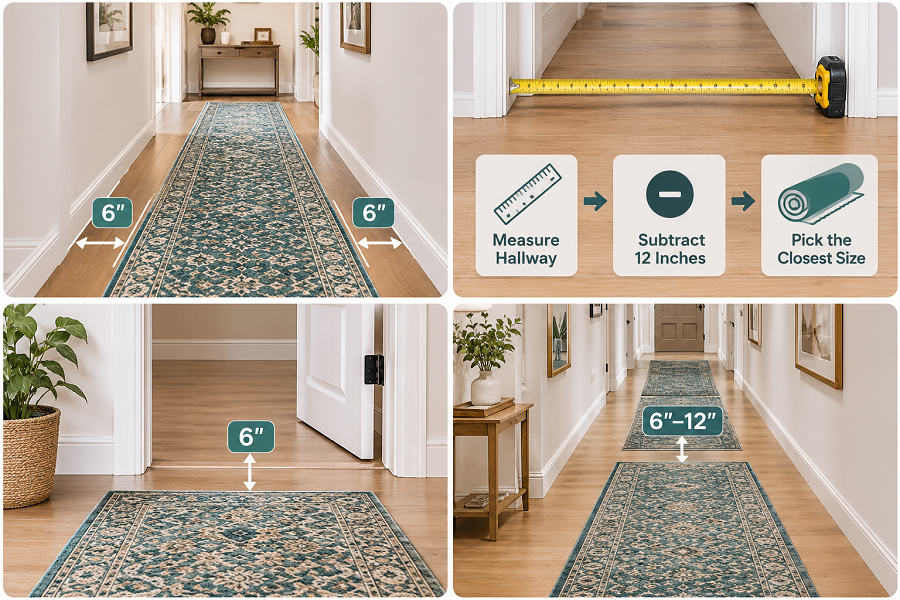
A hallway runner should be about 12 inches shorter than the hallway. That leaves roughly 6 inches of bare floor at each end. For a 10 foot hallway, aim for a runner near 9 feet, or the closest standard size below that, such as 8 feet.
A Simple Length Formula
- Measure the hallway from wall to wall.
- Subtract 12 inches.
- Pick the longest runner that is not longer than your answer.
Here is an example. Say your hallway is 10 feet 6 inches long, which is 126 inches. Subtract 12 and you get 114 inches, or 9 feet 6 inches. A 9 foot runner fits. An 8 foot runner is the nearest standard size if you cannot find a 9.
How Far to Stop From Doors and Corners
Stop the runner about 6 inches before a doorway or a hall that crosses yours. This keeps the rug from creeping under door frames. Then walk the hall and watch how each door swings. Alow to medium pile, about a quarter to half an inch, usually clears a door. Thick or shaggy pile can catch. If an entry door opens into the hall, start the runner just past the spot where the door opens fully.
When the Hallway Is Over 20 Feet
Very long hallways are easier to handle with two matching runners placed end to end, with a gap of 6 to 12 inches between them. One custom piece that long costs more, is harder to find, and is heavy to clean. Two pieces also let you replace the one that wears out first. Place the break where it is least likely to cause a trip, and never in the middle of a doorway.
One Long Runner or Two Shorter Ones?
Choose one runner when a standard size fits your hallway well and the hall has no natural break. Choose two when the hall is very long, has a bend, or when a single long runner is hard to find or too costly. If you go with two, keep them in the same style, as the rules below explain.
How Wide Should a Hallway Runner Be?
Leave 4 to 6 inches of bare floor on each side of the runner. In a tight hallway, 3 inches is the least that still looks planned. Most hallway runners are 2 to 3 feet wide.
The 3 to 6 Inch Gap Rule
The bare strip works like a frame. It shows off the rug, keeps edges away from baseboards, and makes the rug look chosen on purpose. A runner that touches both walls reads as wall-to-wall carpet. A runner that is too thin looks like a strip of tape on the floor.
Runner Width for Narrow Hallways
Older homes and apartments often have hallways around 30 to 36 inches wide. A 2 foot runner is usually the right fit there. If the hallway is so tight that even 2 feet leaves less than 3 inches per side, a narrower runner or a smaller rug in the open part of the hall may look better.
Runner Width for Wide Hallways
In a wide hall, leave a larger border, around 6 to 8 inches, so the rug does not get lost in the space. If the hallway is close to 5 feet wide or more, think about a small area rug instead, or a runner that sits under a console table.
Hallway Runner Rules to Follow
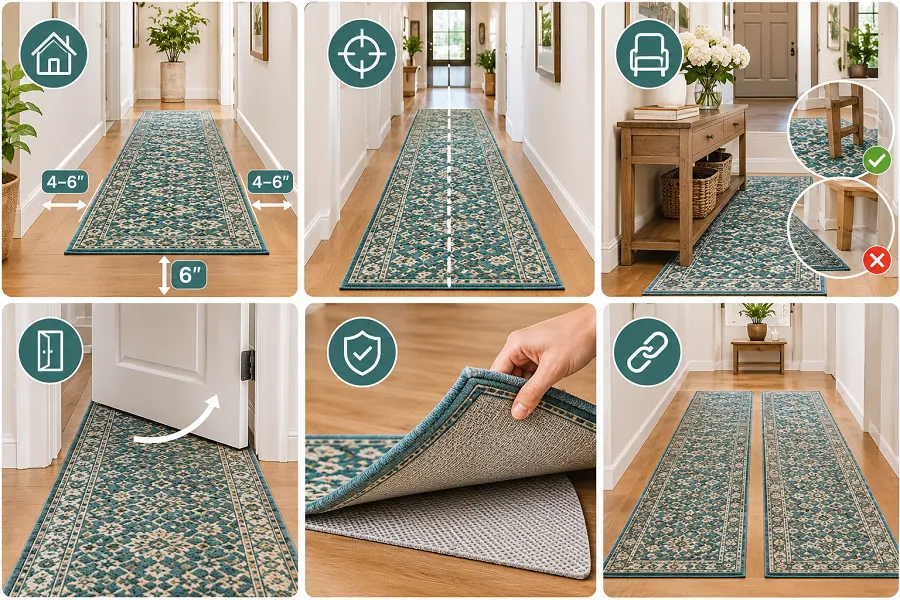
These six rules come up again and again with designers and rug sellers, and they hold up in real homes.
- Leave bare floor on all four sides. Think 4 to 6 inches along the walls and about 6 inches at each end.
- Center the runner. Place it in the middle of the hallway width and keep it straight, so the borders look even.
- Keep furniture legs all on or all off. If a console or bench sits in the hall, follow the same idea as living room rug placement: set its front legs fully on the runner, or leave a few inches of floor between the furniture and the rug. Legs that just touch the edge look crowded.
- Check pile height against door swing. Doors should glide over the rug without catching.
- Always use a pad or tape. Runners are light and walked on all day, so they move.
- Match the pair if you use two. Choose runners in the same style and material, and in close colors, so they look like family.
How to Measure a Hallway for a Runner
Good measuring takes ten minutes and saves a return.
What You Need
A tape measure, a pencil, paper, and painter’s tape. A helper makes long hallways easier.
Step-by-Step Measuring
- Measure the full length of the hallway, wall to wall. Write it down in inches.
- Measure the width at the narrowest point, not the widest. That is where clearance matters most.
- Subtract 12 inches from the length to find the longest runner that works.
- Subtract 6 to 12 inches from the width to find the runner width. This keeps 3 to 6 inches of floor on each side.
- If the hallway bends or meets stairs, measure each straight section on its own.
- Note where each door opens, and how thick the rug can be before it catches.
The Painter’s Tape Test
Before you buy, mark the rug size on the floor with painter’s tape. Make a rectangle with the exact length and width you plan to order. Leave it for a day. Walk the hall with your arms full, open every door, and look at it from both ends. If the shape feels wrong, you have fixed it for free.
Where to Place a Runner Rug in a Hallway
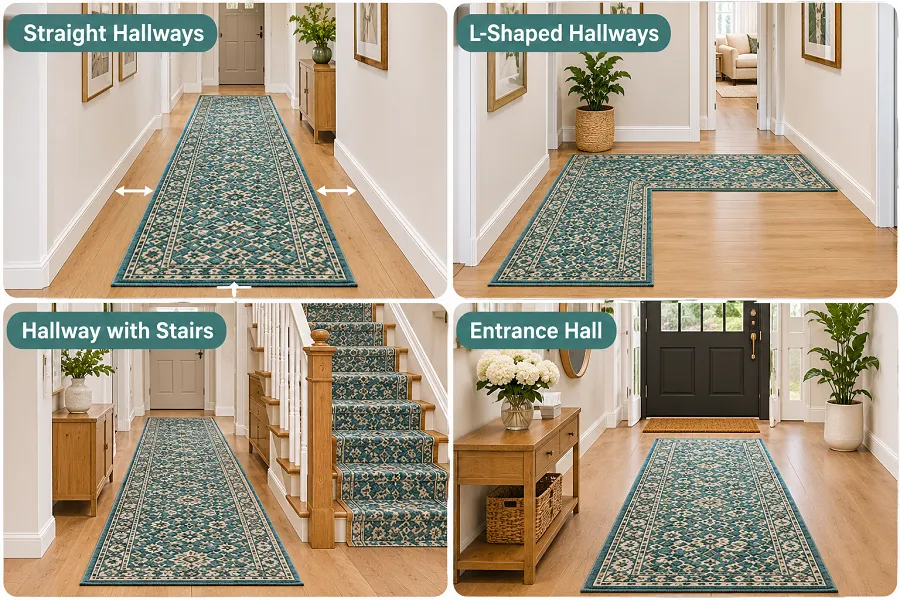
Where the rug sits matters as much as how big it is.
Straight Hallways
This is the easy case. Center the runner on the width of the hall and run it in one piece through the straight stretch. Stop short of doorways at either end.
L-Shaped and T-Shaped Hallways
Bends cannot take a single straight rug. Measure each straight arm separately and use one runner per arm. For a T shape, one long runner and two short ones can work. Keep the runners in the same style so the whole area looks like one plan.
Runner Rugs for Hallways That Lead to Stairs
If your upstairs hall runs into a staircase, use separate pieces for the hall and astair runner for the steps. Choose the same fiber and a similar tone for both. Leave a few inches of bare floor at the top step so the rugs do not meet at an edge where someone could trip.
Entrance Hall and Entryway Placement
An entrance hall takes mud, rain, and the front door swing. Pick a low pile that clears the door, and a pattern that hides dirt. Keep the 3 inch border in tight entries. Put a doormat outside or just inside so the runner stays cleaner.
Should a Runner Match the Area Rug?
No. A runner does not need to match the nearby area rug. It should share a color, a style, or a similar level of pattern, so the two look related instead of random.
Matching Colors Across Rooms
Pick one color that shows up in the rooms on each side of the hall, such as the blue in aliving room rug or the rust in a bedroom throw. Using it in the runner links the rooms without making everything identical.
Mixing Patterns Without Clashing
When both rugs have strong patterns, keep one simple. A bold pattern in the living room works best beside a runner with stripes or a small repeat. Two busy patterns of the same size tend to compete.
Best Materials for Hallway Runner Rugs

Hallways are tough on rugs, so fiber matters more here than in a bedroom.
Wool
Wool springs back under foot traffic, hides dirt well, and its natural oils give you a little time to blot a spill. It costs more and usually is not machine washable.
Polypropylene and Polyester
Synthetic fibers resist stains and are easy to clean. They suit homes with kids and pets, and many are budget friendly. Look for a dense, low pile so the rug keeps its shape.
Cotton and Flatweave
Cotton and flatwoven runners are thin, so doors clear them easily. Many can be washed. They may show wear sooner than wool in the busiest halls.
Jute and Natural Fibers
Jute, sisal, and seagrass add texture and a relaxed look. They soak up moisture, so keep them in dry hallways and away from wet entrances.
| Material | Wear resistance | Cleaning | Best for |
| Wool | High | Spot clean, professional care | Busy family hallways |
| Polypropylene | Good | Easy, some are washable | Kids, pets, entrances |
| Polyester | Good | Easy | Soft feel on a budget |
| Cotton | Fair | Often machine washable | Light traffic, casual style |
| Jute | Fair | Vacuum, avoid water | Dry, quiet hallways |
Washable Runners
A washable runner goes in the machine after muddy shoes or a pet accident. That is a real time saver in a high-traffic hall.
What to Check Before You Buy
- The care label, including the size your washer can handle. Long runners can be bulky.
- The backing. Some washable runners need a separate non-slip pad.
- Wash instructions, such as cold water and a gentle cycle, to protect color and shape.
Long Hallway Runner Ideas
Long hallways have room for personality. These ideas work because each one solves a real problem, such as a dark space or a boxy shape.
Bold Color for Dark Hallways
Hallways often get little daylight. A runner in green, rust, or dark blue adds life to a space with no windows and gives the eye something to follow.
Stripes to Make a Hallway Look Longer or Wider
Stripes that run down the length of the rug pull the eye forward and make the hall feel longer. Stripes that run across the rug can make a narrow hallway feel a little wider.
Vintage and Oriental Patterns
Busy traditional patterns, such as Persian and Turkish designs, hide dirt and suit wood floors and older homes. A faded vintage look can also soften a very formal space.
Neutral and Textured Runners for Modern Homes
A flatweave or heathered wool runner in a calm tone works well with tile, concrete, and pale oak. The texture adds interest without adding noise to the design.
Layering a Runner Over a Larger Rug
In an open-plan home where the hall flows into a living area, a runner can sit on top of a larger flatweave or jute rug to mark the path. Keep the base rug thin so the runner stays flat and does not trip anyone.
Hallway Carpet Ideas and Entrance Hall Carpet Ideas
Some people prefer fitted carpet to a loose runner. A dense, low-pile carpet in a mid tone hides marks and stands up to traffic. You can still lay a runner on top to add color and protect the center path.
Low-Pile Options for Busy Entrances
An entrance hall needs a flat, tight surface that sheds dirt and clears the door. Low-pile or flatwoven runners do this well and are quick to vacuum.
Darker or Busier Patterns Near the Door
Where the dirt comes in, go darker or add pattern. Both hide the footprints people bring from outside before you have time to clean.
Lighter, Plusher Options for Upstairs Hallways
Upstairs halls often see bare feet and fewer muddy shoes. You can use a lighter color and a softer, thicker texture there, as long as the rug still clears the doors.
How to Keep a Hallway Runner From Slipping
Stability is not optional in a hallway. A sliding runner is a trip hazard.
Choosing a Rug Pad
A non-slip pad grips the floor, protects the finish, and adds a little cushion. Cut it about 1 inch smaller than the rug on every side so it does not peek out. Felt and rubber pads work well on hardwood and tile.
Runner on Hardwood vs. Runner on Carpet
The pad you use depends on the floor underneath.
On Hardwood or Tile
Use a rubber or felt and rubber pad. The runner has nothing else to grip, so skipping the pad is the most common cause of sliding.
On Carpet
Use a thin gripper made for rugs on carpet. A thick rubber pad can bunch against carpet fibers instead of holding the runner flat.
Rug Tape and When to Use It
Rug tape works when a pad would make the runner too thick for the door. Press it along the edges and corners. Be careful on finished wood, because some tapes leave residue or are hard to peel off when you want to change the rug.
Fixing Curled Corners and Ends
New runners often arrive rolled and curl at the ends. Lay the rug flat for a few days, or roll it loosely in the opposite direction for a few hours. Heavy books on the ends can help in the meantime.
How to Clean and Care for a Hallway Runner
Vacuum weekly so grit does not settle into the fibers. For wool and handmade rugs, use suction only and keep the beater bar off, because it can pull and fray the edges. Blot spills with a clean cloth right away and do not scrub.
For non-washable runners, professional cleaning every 12 to 18 months keeps them fresh. Turn the rug around once a year so wear spreads evenly. If you use a robot vacuum, tuck the fringe under or choose a runner without it.
Common Hallway Runner Mistakes
- Too wide: the rug looks like carpet. Leave 3 to 6 inches of floor on each side.
- Too short: it looks lost. Use the length formula and stay within 12 inches of the hall length.
- Wall to wall length: it feels cramped. Stop 6 inches before doorways.
- No pad: it slides. Add a pad or tape.
- Door catches: the pile is too thick. Pick a low pile or start past the door swing.
- Mismatched pair: two runners clash. Keep the same style and close colors.
Frequently Asked Questions
How long should a hallway runner be?
A hallway runner should be about 12 inches shorter than the hallway, leaving about 6 inches of bare floor at each end. For a 10 foot hallway, look for a runner near 9 feet, or an 8 foot runner if a 9 foot size is not available.
What size runner rug do I need for a hallway?
Most hallways need a runner 2 to 3 feet wide. Measure the narrowest part of the hall, subtract 6 to 12 inches, and choose the closest standard width. Then subtract 12 inches from the hall length to find the runner length.
How much floor should show around a runner?
Leave 4 to 6 inches of bare floor along each side. In a very tight hallway, 3 inches is the least that looks planned. At the ends, leave about 6 inches, and stop short of doorways.
Can I use two runners in one hallway?
Yes. Two matching runners work well in hallways over about 20 feet, or where there is a natural break. Leave a gap of 6 to 12 inches between them, and keep the break out of the doorway.
What is the best material for a hallway runner?
Wool is the top choice for durability and stain resistance. Polypropylene and polyester are good, lower-cost options that clean easily. Choose a low pile so doors clear the rug.
Do runner rugs need a pad?
Yes, in almost every case. A pad stops sliding, protects the floor, and adds cushion. If a pad is too thick for your door, use rug tape instead.
Can I put a runner over carpet?
Yes. Use a thin rug-on-carpet gripper instead of a thick rubber pad, and make sure the runner is centered and flat. Check the edges now and then for bunching.
How do I stop a runner from sliding?
Use a non-slip pad cut about 1 inch smaller than the rug on all sides. On hardwood, choose rubber or felt and rubber. On carpet, use a thin gripper. Rug tape is a good backup.
Final Thoughts
A good hallway runner comes down to three things: the right length, the right width, and a pad that keeps it in place. Leave 3 to 6 inches of floor along the sides, about 6 inches at each end, and check how your doors swing before you buy.
The numbers in this guide are general guidelines for typical homes. Every hallway is different, so measure your own space, test the size with painter’s tape, and adjust to what looks right to you.