Rugs are categorized in product taxonomies using two layers. The first layer is a category tree that says what the product is. The second layer is a set of attributes that says what kind of rug it is, such as construction, material, origin, size, shape, style, color, and pile height.
That sounds simple, but one rug can be hand-knotted, made of wool, woven in Iran, 60 years old, runner-shaped, and red. Which of those facts belongs in the menu? Which belongs in a filter? Stores that guess end up with messy menus, duplicate products, and shoppers who leave.
This guide shows how customs offices, government data, and online platforms classify rugs and carpets. Then it walks Carpet Land through building a clean rug taxonomy for its online store, with a sample category tree, common mistakes, and an audit checklist you can use today.
Key Takeaways
- A rug taxonomy is a planned system of categories, attributes, and allowed values.
- Categories answer “What is it?” Attributes answer “What kind is it?”
- How a rug is made is the strongest first split. Customs rules use it too.
- Age and quality labels have no single standard, so publish your own rules.
- Keep the category tree short. Move traits that shoppers combine into filters.
- A clean taxonomy helps shoppers, search engines, product feeds, and AI answer tools.
What Is a Product Taxonomy for Rugs?
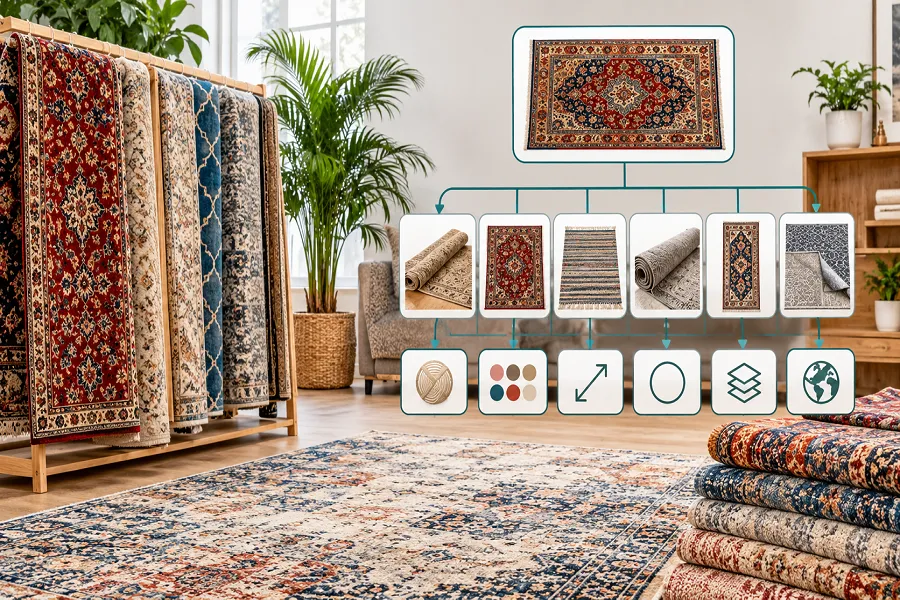
A product taxonomy for rugs is a planned system that puts every rug in a clear place. It uses a category tree, attributes, and fixed values so that people and machines can find, compare, and understand each rug the same way.
Think of it as a filing system for your catalog. A good one lets a shopper find a low-pile wool runner in two clicks. A poor one hides that same rug in a menu called “Misc.”
Taxonomy vs Category vs Attribute vs Filter
People mix up four terms. This table keeps them apart.
| Term | What it means | Rug example |
| Taxonomy | The full system of categories, attributes, and values | The whole structure of a rug catalog |
| Category | A place in the tree that says what a product is | Runners |
| Attribute | A fact about the product | Material: wool |
| Filter | A site control that narrows products by an attribute | Pile height: low |
One attribute can power one filter. That link matters later, when you decide what goes in the menu and what goes in the sidebar.
Why Rug Categorization Matters
Rugs are harder to sort than most home goods. Shoppers buy them without touching them. They compare construction, fiber, size, and origin, often for the first time. A clear taxonomy helps in four ways:
- Shoppers find the right rug faster and trust what they see.
- Search engines understand how your pages relate to each other.
- Product feeds pass platform checks with fewer errors.
- AI answer tools read consistent labels and repeat them correctly.
Bad labels cost you in all four places at once. Good labels pay you back in all four.
How Do Official Systems Classify Rugs?
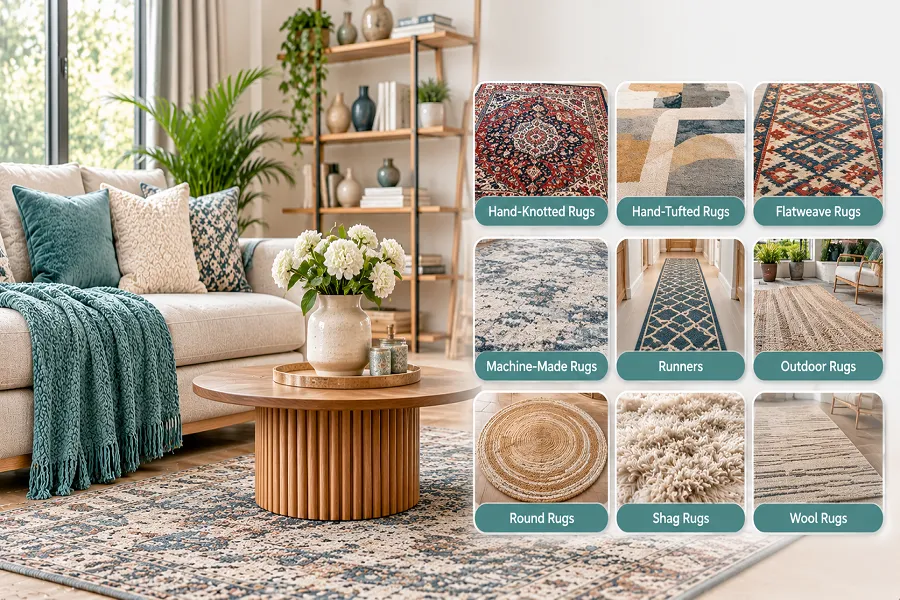
Before you build your own tree, look at how official systems do it. Each one sorts rugs for a different reason. They still agree on one lesson: how a rug is made matters most.
Customs and Tariff Classification
Customs offices use the Harmonized System, a global code list for traded goods. Chapter 57 covers carpets and other textile floor coverings. Its main headings split rugs by construction:
- 5701: knotted carpets and rugs
- 5702: woven carpets and rugs that are not tufted, including hand-woven flatweaves such as kilims
- 5703: tufted carpets and rugs
- 5704: felt floor coverings
- 5705: other textile floor coverings
Fiber is a second split. Many subheadings separate wool or fine animal hair from other textiles. National schedules add more detail, such as hand-knotted versus machine-made.
This tells you something useful. Officials who have to put a price and a rule on every rug chose construction as the first question. Tariff rates and rules change, so check the current official schedule before you use any code.
Government and Waste Data Categories
The US Environmental Protection Agency tracks waste by product group. It places carpets and rugs inside durable goods, which are products built to last three years or more. Carpets and rugs get their own line, apart from furniture and furnishings. Official data treats rugs as a floor covering family, not as a type of furniture.
Marketplace and Platform Taxonomies
Online platforms use taxonomies to run feeds, search, and tax rules. Shopify’s Standard Product Taxonomy is a tree of categories, attributes, and values. Each product gets one product category, and Shopify says to pick the most specific one. Category metafields then hold facts such as color and material. Google Merchant Center also asks for a product category plus details such as color, material, pattern, and size.
In these systems, rugs usually sit as a single category under Home & Garden, then Decor. Finer facts, such as construction or origin, often have no branch of their own. They live in attributes or in your own filters. Platforms update their files, so check the current official list before you map products.
This gives you a clear job. The platform tree stays short. Your own store taxonomy carries the rest.
What Are the Main Ways to Categorize Rugs?
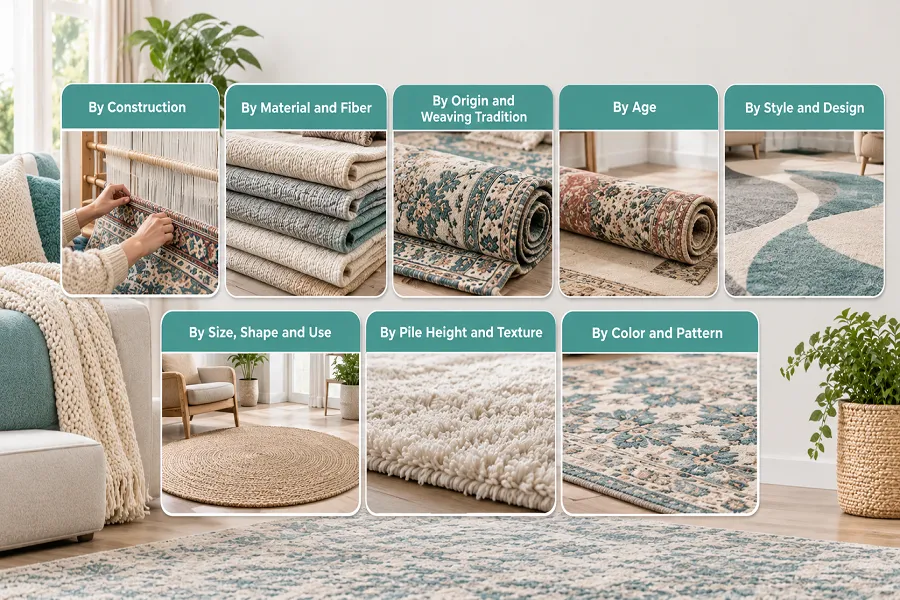
Rugs carry many traits at once. This table lists the most common ones and where each usually belongs in a store.
| Attribute | Example values | Usual home |
| Construction | Hand-knotted, hand-tufted, hand-hooked, machine-made, flatweave, braided | Category |
| Material | Wool, silk, cotton, jute, nylon, polyester, polypropylene, blends | Filter |
| Origin | Country, region, weaving tradition | Filter |
| Age | Antique, semi-antique, vintage, modern | Filter |
| Style | Traditional, transitional, contemporary, bohemian, coastal | Filter |
| Size | 5×8 ft, 8×10 ft, runner lengths | Filter |
| Shape and use | Rectangle, round, runner, indoor, outdoor | Category or filter |
| Pile height | Flatweave, low, medium, high, shag | Filter |
| Color and pattern | Red, blue, floral, geometric | Filter |
The sections below explain each one.
By Construction
Construction describes how a rug is made, and it is the main way shoppers tell rug types apart. It shapes durability, feel, price, and care. Common values include:
- Hand-knotted: A weaver ties yarn by hand around the warp threads on a loom. Fine rugs hold thousands of knots in each square foot. Weavers use two main knots, called symmetrical (Turkish) and asymmetrical (Persian). The names describe the knots, not the countries.
- Hand-tufted: A worker pushes yarn through a backing cloth with a hand tool. A coating then holds the tufts in place.
- Hand-hooked: A worker pulls loops or tufts through a base with a hook.
- Machine-made: A machine weaves or tufts the rug. Output is fast and consistent.
- Flatweave: The rug has no pile. Weft threads form the design, as in kilims and soumak.
- Braided: Makers braid cords or strips and coil them into shape.
You can often check construction on the back. Knotted rugs show the pattern clearly on the back, while tufted rugs usually show a backing cloth. For fine hand-knotted rugs, knot density, counted as knots per square inch, tells shoppers how detailed the design can be.
By Material and Fiber
Wool is the most common pile fiber in handmade rugs. Silk adds sheen and costs more. Cotton often forms the foundation, and cotton, jute, and sisal also appear as pile. Machine-made rugs often use nylon, polyester, polypropylene, or viscose.
Track pile material and foundation material as two fields. They affect care and repair in different ways. Add a blend value for mixed fibers.
By Origin and Weaving Tradition
Origin tells shoppers where and how a rug was made. Keep it clean with two separate fields.
Country of Origin vs Design Style
“Persian” means woven in Iran. A rug woven in India, Pakistan, or China in a Persian design is Persian-style. Dealers often use labels such as Indo-Persian for these rugs. Always state the country of origin and the design name together.
City, Village and Nomadic Rugs
City workshops follow drawn designs and tie fine, even knots. Village and nomadic weavers often work from memory, with bolder patterns and looser weaves. Neither type is better. If you sell handmade rugs, add a weaving category field. Add a region or design name too, such as Tabriz, Heriz, or Qashqai.
By Age
Age affects value, care, and repair. Yet no single standard exists. Some sellers call a rug antique at 100 years, while others use 60. Semi-antique starts at 25 years in some glossaries and 50 in others. Vintage has no fixed meaning.
Why Antique, Semi-Antique and Vintage Cutoffs Differ
Trade glossaries do not agree on one shared cutoff, so each seller picks its own. You should do the same, then say so. Publish your rule, such as “antique means 100 years or older,” and apply it to every product. Keep the ranges from overlapping. State age only when you can verify it.
By Style and Design
Style describes the look. Traditional rugs use borders, a central medallion, and strict symmetry. Transitional rugs soften those details. Contemporary rugs favor abstract shapes and uneven layouts. Many stores add bohemian, coastal, farmhouse, and mid-century.
Treat layout as a separate field: medallion, all-over, prayer, garden, or panel. Define each style in one sentence, because style words are subjective.
By Size, Shape and Use
Area rug is the broad term for a rug that covers part of a floor. Size values should match how people shop, such as the standard rug sizes 5×8 ft (about 150×240 cm) and 8×10 ft (about 240×300 cm). Shape values include rectangle, round, square, oval, and runner. Use values include indoor, outdoor, and high-traffic.
Many stores make runners their own category, because shoppers search for hallway carpets or stair runners.
By Pile Height and Texture
Pile height changes how a rug feels and how you clean it. Use clear steps: flatweave, low pile, medium pile, high pile, and shag. No standard measurement exists, so publish your own ranges in millimeters or inches.
By Color and Pattern
Use a short base color list, such as blue, red, and neutral, and name the exact shade in the description. Pattern values might be floral, geometric, abstract, striped, and solid. Shopping platforms ask for both color and pattern, so fill both in.
Should Rug Attributes Be Categories or Filters?
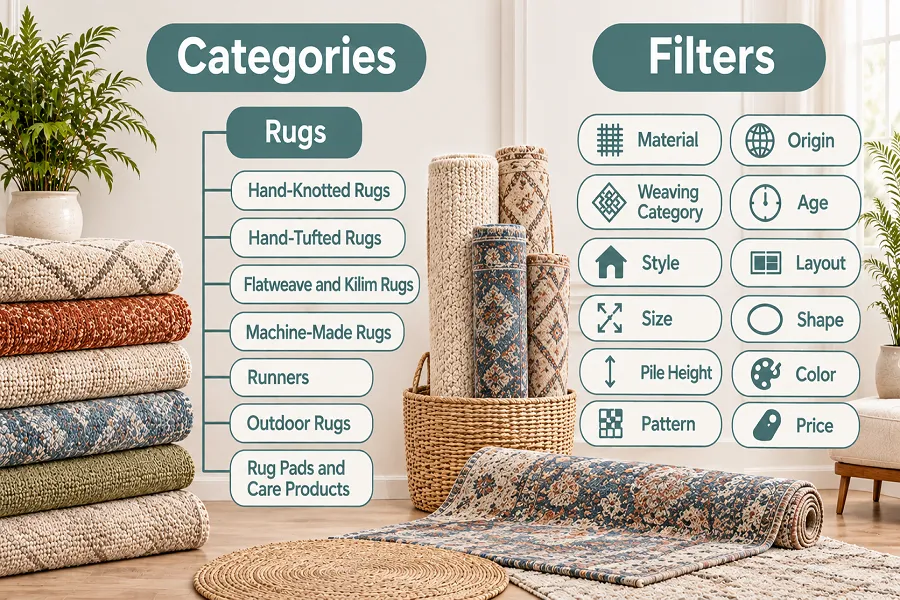
This is the question that trips up most stores. A simple rule settles it.
A Simple Rule to Decide
Use a category for what a product is. Use a filter for a trait that shoppers combine with others. Ask four questions about each attribute:
- Would a shopper use it to pick a whole section of your store?
- Does every rug have exactly one value?
- Does the value stay the same over time?
- Do shoppers rarely combine it with other traits?
Four yes answers point to a category. Anything else points to a filter.
Construction passes the test for most stores. Color fails, because shoppers combine red with size, material, and price. Runners are a special case. Shoppers search by use, so many stores give them a category.
Sample Rug Taxonomy
This tree works for a store that sells handmade and machine-made rugs. Adjust it to fit your catalog.
- Rugs (top level)
- Hand-Knotted Rugs
- Hand-Tufted Rugs
- Flatweave and Kilim Rugs
- Machine-Made Rugs
- Runners
- Outdoor Rugs
- Rug Pads and Care Products
- Filters on every category: material, origin, weaving category, age, style, layout, size, shape, pile height, color, pattern, and price
Each rug lives in one main category and shows up in many filter results. Build collection pages for high-demand combinations, such as wool runners or Persian-style rugs, and let filters fill them. Keep the tree to three levels or fewer.
Common Rug Taxonomy Mistakes
- Overlapping categories. “Handmade” and “Hand-Knotted” sit side by side, but one contains the other.
- Mixed levels. “Wool,” “Round,” and “Persian” appear as siblings, though each describes a different trait.
- Vague labels. “Oriental” means different things to different sellers unless you define it.
- One rug in many categories. This creates duplicate URLs and confuses shoppers.
- Too many levels. Rugs buried four clicks down rarely get found.
- Free-text values. “Hand knotted,” “hand-knotted,” and “handknotted” become three separate filter options.
- Unverified claims. Labeling a rug antique or Persian without proof hurts trust and can break platform rules.
How to Build a Rug Taxonomy Step by Step
Follow these six steps. Each one builds on the last.
Audit Your Catalog
Export every product. List each rug type, label, and category. Mark gaps, duplicates, and inconsistent spellings. This shows you how messy things are today and where to start.
List Every Attribute Shoppers Use
Read your site search terms, customer questions, and return reasons. Check the filters on stores you admire. Add any fields that shopping platforms require, such as brand, color, material, and size.
Sort Attributes Into Tree or Filters
Apply the four-question rule from the last section. Keep the tree short, and send the rest to filters. Test the result by asking a coworker to find three different rugs without help.
Define Labels and Allowed Values
Write one clear sentence for each value. Use fixed lists, not free text. Set units, spelling, and rules for age and pile height. Keep these in a short style guide so every person on your team labels rugs the same way.
Map to Platform Categories and Feed Fields
Match each product to the most specific platform category. Fill in feed fields such as brand, color, material, size, pattern, and product ID codes like GTIN when you have them. Keep your store tree and the platform category separate, because they do different jobs.
Rug Taxonomy Audit Checklist
Use this list on your own store:
- Does every rug sit in one main category?
- Do sibling categories describe the same kind of trait?
- Does the tree stay within three levels?
- Does each filter value have a clear definition?
- Do you use fixed lists, not free text?
- Do age and pile height follow rules you publish?
- Does each product show country of origin and design name when relevant?
- Do feed categories match the most specific platform category?
- Do breadcrumbs and URLs match the tree?
- Does each category page carry a short definition and unique text?
Frequently Asked Questions
What are the main categories of rugs?
Rugs are grouped by construction, material, origin, age, style, size, shape, and pile height. Most stores use construction or use, such as hand-knotted rugs or runners, for main categories. They treat the other traits as filters, so shoppers can combine them. This keeps the menu short and the search flexible.
How are rugs classified by construction?
Customs codes split rugs into knotted, woven (including hand-woven flatweaves), tufted, and felt. Stores add finer labels, such as hand-knotted, hand-tufted, hand-hooked, machine-made, flatweave, and braided. Pick one clear construction value for each rug, and define each term on your site.
What is the difference between hand-knotted and hand-tufted rugs?
A weaver ties a hand-knotted rug knot by knot around the warp threads, so the design is part of the rug’s structure. A worker pushes yarn through a backing cloth to make a hand-tufted rug, and a coating holds the tufts in place. Knotted rugs take far longer to make and often cost more.
How is the age of a rug classified?
No single standard exists. Common labels are antique, semi-antique, vintage, and modern, but cutoffs differ by seller. Some call a rug antique at 100 years, others at 60. Choose your own rule, publish it, and apply it to every product. State age only when you can verify it.
Should rug attributes be categories or filters?
Use categories for what a product is, and filters for traits shoppers combine. A category should stay stable, and each rug should fit in only one. Construction and use often work as categories. Color, material, size, and pile height work better as filters.
What does Persian-style mean?
Persian means a rug woven by hand in Iran. Persian-style means a rug woven elsewhere, such as in India, Pakistan, or China, in a traditional Persian design. Both can be real handmade rugs. List the country of origin and the design name together, so shoppers know exactly what they are buying.
Conclusion
Rugs fit cleanly into a product taxonomy when you split the work in two. The category tree says what a rug is. Attributes and filters say what kind it is. Start with construction, keep the tree short, define every label, and publish your age and quality rules. Then run the audit checklist on your own catalog. One honest fix at a time gives shoppers, search engines, and AI tools the same clear picture.