

Herringbone carpet is carpet with a V-shaped zigzag pattern that looks like the bones of a fish. The lines run in rows, and each row leans the opposite way from the one beside it. That gives a floor gentle movement without a loud look.
It works on stairs, living rooms, bedrooms, and busy hallways. It also hides everyday dirt better than a plain, flat color. In this guide, Carpet Land shares insights into herringbone carpet patterns, how they differ from chevron, and which materials last longer. You will also learn about 10 popular styles, along with practical tips on stairs, cost, buying, and care.
Herringbone Carpet at a Glance
- Pattern: a zigzag of slanted lines that form a repeating V
- Best materials: nylon for heavy traffic, wool for softness, polypropylene for stain resistance
- Best spots: stairs, hallways, living rooms, bedrooms, and offices
- Main benefit: adds texture and movement while staying calm
- Main trade-off: wall-to-wall installs need extra material to match the pattern
What Is Herringbone Carpet?
Herringbone carpet has a repeating pattern of slanted lines that meet in a V shape. When you look at a full room, the rows seem to point in one direction, then flip, then flip back. This creates a soft sense of motion.
The pattern is not new. People have used it in wood floors, woven cloth, and tile for a very long time. Carpet makers borrowed it because it looks classic and still feels modern.
How the Pattern Is Made in Carpet
In wood flooring, herringbone comes from laying short planks at an angle. Carpet works differently. The pattern is built into the carpet itself in one of a few ways:
- Woven: yarns are woven together so the zigzag forms as part of the cloth.
- Tufted with color: yarns of two or more shades are placed in a set order, so the V shape shows through color.
- Loop and cut: some loops stay uncut and some are cut. The mix of heights creates the zigzag through texture.
- Fiber direction: the pile leans in different directions, and light bounces off each row differently.
This is why one herringbone carpet can look bold and another can look almost invisible. The pattern can come from color, texture, or both.
Herringbone vs Chevron Carpet: What Is the Difference?
People mix up these two patterns all the time. They look alike, but they are built differently.
| Feature | Herringbone | Chevron |
| Block ends | Cut straight, at a right angle | Cut at an angle |
| How lines meet | Offset, so one row butts into the next | Meet exactly at a point |
| Overall look | Broken, woven, textured | Smooth, continuous, sharp |
| Mood | Calm and classic | Bold and graphic |
| Best fit | Traditional, farmhouse, and modern rooms | Modern and statement rooms |
In wood and tile, the difference is easy to see because you can see each plank. In carpet, the line between the two blurs, because the yarn runs through the whole piece. Many sellers use the words loosely. So always look at a sample. Check whether the V points meet in one clean line or step into each other.
Why Choose Herringbone Carpet? Pros and Cons
Before you pick a pattern, it helps to know what you gain and what you give up.
Benefits of Herringbone Carpet
- It adds movement without noise. The zigzag gives the eye something to follow, but most versions stay quiet and neutral.
- It hides everyday dirt. A pattern with two or more tones breaks up small crumbs, dust, and light marks better than a solid color.
- It suits many room styles. It looks at home in classic, farmhouse, transitional, and modern spaces.
- It adds texture to neutral rooms. If your walls and furniture are beige, gray, or white, the pattern keeps the room from feeling flat.
- It works in many formats. You can get it as wall-to-wall broadloom, a stair runner, an area rug, or carpet tiles.
Drawbacks to Think About
- Pattern matching adds waste. In a wall-to-wall install, the installer has to line up the pattern across seams. That can mean buying more material.
- High contrast can feel busy. A bold two-tone herringbone in a very small room can feel crowded.
- Cost can vary a lot. Natural fibers and woven constructions often cost more than a basic cut pile carpet.
- Samples can fool you. A small sample may show only a few rows, so you may not see how the pattern behaves across a full room.
10 Popular Herringbone Carpet Styles
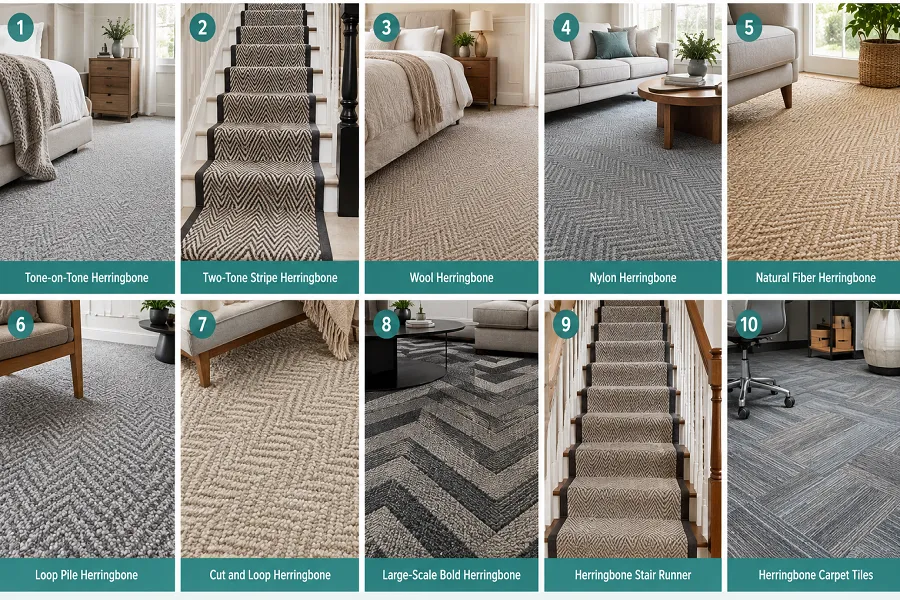
Here are ten styles you will see most often. Each one suits a different room and a different level of traffic.
1. Tone-on-Tone Herringbone
This style uses two shades of the same color, such as light gray and slightly darker gray. The pattern shows up when light hits it, not from strong contrast.
Best for: bedrooms, living rooms, and anyone who wants a calm look.
Keep in mind: the pattern is subtle, so view the sample in your own room light.
2. Two-Tone Stripe Herringbone
Here the zigzag comes from thin stripes in two clearly different colors, such as cream and charcoal. It reads as a classic stair runner look and is common on staircases and hallways.
Best for: stairs, halls, and entryways.
Keep in mind: stripes make the pattern clear, so check that the width suits your stair width.
3. Wool Herringbone
Wool herringbone feels soft and looks rich. The fiber takes color well, which gives the pattern a natural, slightly muted look. Wool is also naturally resilient, so the pile springs back after foot traffic.
Best for: bedrooms, formal living rooms, and quieter areas.
Keep in mind: wool often costs more than synthetic fibers, and spills should be blotted fast.
4. Nylon Herringbone
Nylon is known for strength. It holds its shape well, which makes it a common pick for busy homes and stairs. The pattern stays crisp for longer, even with daily use.
Best for: stairs, hallways, family rooms, and homes with kids or pets.
Keep in mind: look for a dense pile, since density affects how well the carpet wears.
5. Natural Fiber Herringbone
These carpets use fibers such as sisal or jute, or a synthetic version made to look like them. They bring a flat, woven, earthy texture that suits farmhouse and coastal rooms.
Best for: living rooms, offices, and low-moisture areas.
Keep in mind: natural fibers can feel rougher underfoot and can be harder to clean. Synthetic sisal-look options are often easier to maintain.
6. Loop Pile Herringbone
In loop pile, the yarn is left in small loops instead of being cut. The loops can be arranged to form the zigzag. The result is a firm, textured surface that tends to hide footprints and vacuum marks.
Best for: hallways, home offices, and busy family spaces.
Keep in mind: loops can catch on pet claws, so choose a tight, low loop if you have cats or dogs.
7. Cut and Loop Herringbone
This style mixes cut yarn and looped yarn in one carpet. The height change makes a sculpted pattern you can see and feel. It looks richer than a flat weave.
Best for: living rooms, dining rooms, and bedrooms.
Keep in mind: the sculpted look is best seen from a distance, so view a large sample.
8. Large-Scale Bold Herringbone
Some herringbone carpets use wide rows and strong contrast. They act as a design feature and often become the focal point of the room.
Best for: large living rooms, open plans, and statement hallways.
Keep in mind: bold patterns can shrink a small room, so keep the rest of the decor simple.
9. Herringbone Stair Runner
A runner is a strip of carpet down the middle of the stairs. Herringbone is a favorite here because the zigzag draws the eye up the staircase. It also adds grip on slick wood steps.
Best for: staircases, landings, and long halls.
Keep in mind: runners are usually custom cut and bound, so measure carefully before you order.
10. Herringbone Carpet Tiles
Carpet tiles are square pieces that you lay like floor tiles. Some come with a herringbone design. Others are made so you can lay them in a herringbone layout. If a tile gets stained or worn, you replace only that piece.
Best for: home offices, studios, basements, and commercial spaces.
Keep in mind: check that the tile edges line up, or the pattern may look uneven.
Best Materials for Herringbone Carpet
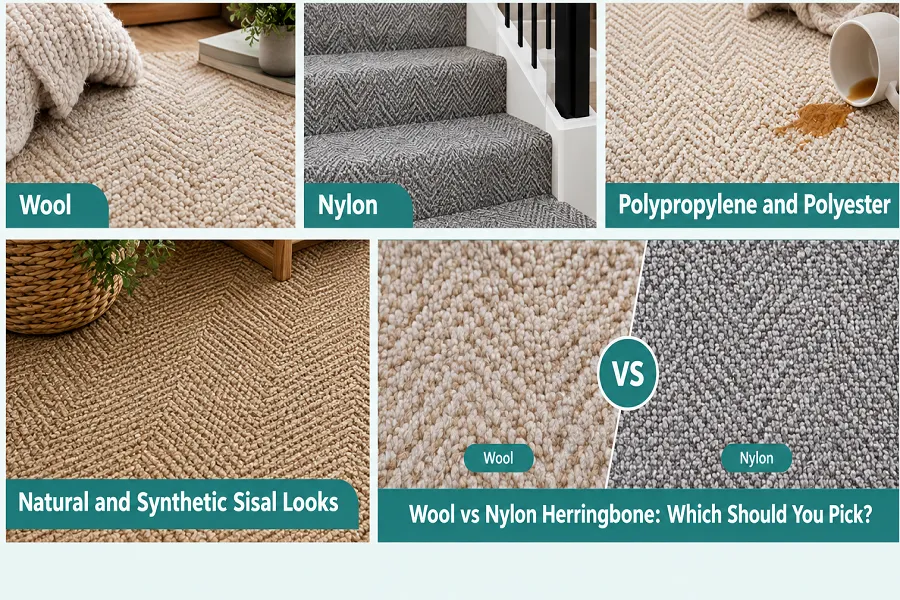
The fiber you pick affects how the carpet looks, feels, and wears. Here is how the main options compare.
| Material | Feel | Durability | Stain resistance | Cost level | Best use |
| Wool | Soft and warm | High | Medium, needs quick care | Higher | Bedrooms, living rooms |
| Nylon | Soft to medium | Very high | Good, especially when treated | Mid | Stairs, halls, busy homes |
| Polypropylene | Medium | Good | High, often colorfast | Lower | Budget projects, basements |
| Polyester | Very soft | Medium | Good | Lower to mid | Bedrooms, low traffic rooms |
| Sisal or jute | Firm and rough | Medium | Low to medium | Mid to higher | Dry rooms, offices |
Wool
Wool is a natural fiber that feels soft and warm underfoot. It springs back well after people walk on it, so the herringbone lines stay neat. It holds dye in rich, muted tones that make the zigzag look classic. It usually costs more than synthetic fibers, and it soaks up liquid, so wipe spills fast.
Nylon
Nylon is one of the strongest carpet fibers you can buy. It resists crushing and wear, so the herringbone lines stay sharp in busy spots. Many stair runners use it because steps take the most daily stress. It is a smart pick for family homes, halls, and staircases.
Polypropylene and Polyester
Polypropylene naturally resists stains and keeps its color well. That makes it handy for homes with kids and for rooms where spills happen. Polyester feels very soft and also offers good stain resistance. In very heavy traffic, it may crush down sooner than nylon.
Natural and Synthetic Sisal Looks
Natural sisal and jute give herringbone a dry, woven look with earthy texture. They suit farmhouse, coastal, and simple modern rooms. They work best where spills are rare, since natural fibers can be hard to clean. If you want the same look with easier care, a synthetic sisal-look carpet may fit better.
Wool vs Nylon Herringbone: Which Should You Pick?
Choose wool if softness and a natural feel matter most, and the room sees light to medium use. Choose nylon if the carpet will face daily heavy traffic, like stairs or a family hallway. Think about your budget too, since wool often costs more. If you cannot decide, ask for samples of both and compare them in the room.
Herringbone Carpet for Stairs and Landings
Herringbone stair carpets add style to narrow steps, while the zigzag pattern draws the eye up the staircase.
Why Herringbone Works Well on Stairs
- It hides wear. Stairs take the most stress, and a pattern with two tones masks small marks.
- It adds grip. Bare wood can be slippery, especially in socks. A carpet runner gives your feet better traction.
- It softens noise. Carpet absorbs sound, so footsteps feel quieter.
- It looks good from the bottom. Stripes and V shapes stack neatly step after step.
Runner or Full Carpet on Stairs?
A runner covers the center of each step and leaves a strip of wood on each side. It shows off your stair wood and usually uses less material. Full wall-to-wall carpet covers each step edge to edge. It feels softer and warmer, but it covers the wood.
Runners are the more popular herringbone choice because the pattern gets room to stand out.
How to Handle Landings and Turns
Landings and turns are the trickiest part. A landing is the flat platform between two flights of stairs. A turn may use angled steps called winders.
- Plan the pattern direction before cutting, so the zigzag flows from the stairs onto the landing.
- Ask your installer how the runner will meet the landing. Some carpet is made in matching landing pieces.
- Expect extra material when the stairs turn, because the pattern must stay lined up.
Pattern Alignment Tips
- Center the runner on each step so both side gaps look even.
- Choose a runner with finished, bound edges for a clean, safe finish.
- Make sure the pattern is cut straight, not on a slant, or the V shapes will drift across the stairs.
Do You Need Underpad on Stairs?
Yes, it is a smart add-on. An underpad sits between the carpet and the stair. It adds comfort, helps the carpet stay in place, and can help it wear more evenly. Ask your supplier which pad works with your carpet type.
Herringbone Carpet Wall to Wall vs Area Rug
You can use herringbone as a full floor covering or as a rug. Each has its place.
Wall-to-Wall Herringbone
Wall-to-wall carpet, also called broadloom, covers the full floor. It feels cozy and makes a room seem unified. But it needs careful planning.
- The installer must match the pattern at every seam.
- You may need extra carpet to allow for the match.
- Seams should be placed where they are least visible, such as away from the main door.
Herringbone Area Rug or Custom Size Rug
A herringbone area rug gives you the look without covering the whole floor. Many suppliers can cut and bind a custom size from a roll of carpet.
- It is easier to move or replace.
- It lets your wood or tile floor show.
- A custom size lets you fit odd spaces, like a long hallway.
Which one is right for you? Pick wall-to-wall for bedrooms and cozy living spaces. Pick a rug or runner if you like flexibility, or if you want to show off the floor beneath.
Herringbone Carpet Design Ideas by Room
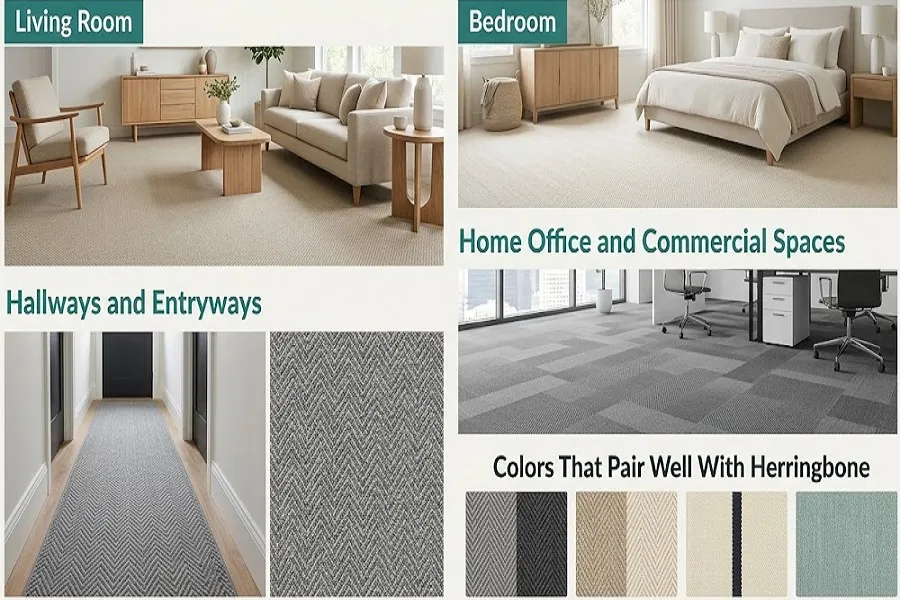
Herringbone does not look the same in every room. Size, light, and daily traffic change how the zigzag shows up, so here is how it works in each space.
Living Room
Pair a neutral herringbone with natural wood, linen, and soft lighting. Gray or beige living room carpets with a tone-on-tone herringbone pattern create a calm, balanced look. If your furniture is plain, a bold, large-scale pattern can become the room’s focal point.
Bedroom
Keep the bedroom soft and peaceful with bedroom carpets in a low-contrast herringbone pattern. Wool or a soft synthetic carpet feels comfortable underfoot, while light shades help the room feel bright and airy.
Hallways and Entryways
A herringbone runner is a natural fit. The zigzag tends to pull the eye along the length of the hall. Choose a tough fiber like nylon, since halls take daily traffic.
Home Office and Commercial Spaces
Tone-on-tone herringbone office carpets create a neat, professional look. Carpet tiles are practical because you can replace individual pieces if they become worn or stained.
Colors That Pair Well With Herringbone
- Gray and charcoal: modern and calm
- Beige and cream: warm and classic
- Ivory with a dark stripe: crisp and traditional
- Soft blue or green tones: fresh, good for bedrooms
As a simple rule, the smaller the room, the lower the contrast should be.
How Much Does Herringbone Carpet Cost?
Prices change by region, supplier, and quality, so there is no single number. Instead, it helps to know what moves the price up or down.
- Fiber: wool and natural fibers usually cost more than polypropylene or polyester.
- Construction: woven and sculpted carpets often cost more than basic tufted ones.
- Density and weight: a thicker, denser carpet uses more yarn and costs more.
- Custom work: cutting, binding, and sewing a runner or rug adds to the price.
- Underpad: a good pad is an extra cost but protects your carpet.
- Installation: stairs, landings, and pattern matching take more skill and time.
- Waste: matching the pattern means you may buy more than the floor area.
Always ask for a written quote that lists the carpet, pad, labor, and any extra material.
What to Check Before You Buy
A little prep saves money and stress.
Ask for a Sample
Look at the sample in your room at different times of day. Natural light, lamp light, and shadow change how a pattern looks. Place it on the floor, not on a table.
Measure and Plan for Pattern Waste
Measure the room, or the stairs, carefully. Tell your supplier you want a patterned carpet so they can add the right extra amount for matching.
Check Traffic Rating, Fiber, and Warranty
Ask what kind of use the carpet is made for. A bedroom carpet and a stair carpet do not need the same strength. Also ask what the warranty covers.
Where to Buy: Showroom, Custom Supplier, or Online
- Showroom: best for touching samples and getting advice.
- Custom supplier: best for runners, odd sizes, and bound rugs.
- Online: handy for browsing, but always order a sample first.
Whichever route you choose, ask who handles installation and whether they have experience with patterned carpet.
How to Clean and Care for Herringbone Carpet
Good care helps herringbone carpets keep their pattern and texture for years. Learning how to clean a carpet properly helps remove everyday dirt and prevent stains from settling into the fibers. Vacuum regularly and treat spills quickly to keep the carpet looking its best.
Weekly Care
- Vacuum at least once a week. In busy areas, vacuum more often.
- Go slowly, so the machine can lift dirt out of the pile.
- Move furniture a little from time to time so the carpet wears evenly.
Spot Cleaning Tips
- Act fast. Blot the spill with a clean cloth. Do not rub, since rubbing pushes the stain in and can blur the pattern.
- Use a mild cleaner made for your carpet type.
- Test any cleaner on a hidden spot first.
Herringbone Carpet FAQs
Q1. What is herringbone carpet?
Herringbone carpet is carpet with a V-shaped zigzag pattern that looks like fish bones. The pattern can come from weaving, color, loops, or fiber direction. It is popular for stairs, halls, and living spaces.
Q2. Is herringbone carpet good for stairs?
Yes. The pattern hides wear, adds grip, and looks good from the bottom of the stairs. Choose a strong fiber like nylon and add an underpad for comfort and wear.
Q3. What is the difference between herringbone and chevron carpet?
Herringbone has offset rows that step into each other at a right angle. Chevron has lines that meet at a clean point. Herringbone looks calmer and more textured. Chevron looks bolder and sharper.
Q4. Is nylon or wool better for herringbone carpet?
It depends on use. Nylon is better for heavy traffic and stairs. Wool is better if you want a soft, natural feel in a quieter room.
Q5. Does herringbone carpet make a room look smaller?
Not usually. Tone-on-tone and light colors keep a room feeling open. A bold, high contrast pattern in a very small room can feel busy, so keep contrast low there.
Q6. Is herringbone carpet out of style?
No. People have used the pattern in floors and fabrics for a very long time, and it keeps coming back because it suits both classic and modern homes.
Q7. Can you install herringbone carpet wall to wall?
Yes. Expect extra material so the installer can match the pattern at seams. Ask for an installer who has worked with patterned carpet.
Q8. How do you clean herringbone carpet?
Vacuum weekly, blot spills fast, and use a mild cleaner. Avoid hard rubbing. Book a professional clean now and then.
Final Thoughts
Herringbone carpet gives you texture and movement without making a room loud. Pick nylon for stairs and busy halls, wool for soft and quiet rooms, and polypropylene when stain resistance matters most. Choose low contrast for small rooms and bolder patterns for big ones.
Order samples, measure twice, and plan for extra material to match the pattern. If you need help picking a style or fiber, talk to a carpet expert or book a free consultation to see samples in your own space.