

The best rug for a classroom is strong, easy to clean, safe and big enough for every child to have a spot. Choose a low to medium pile, a non-slip backing and stitched edges. Then size it by counting how many children will sit on it at once. About 4 square feet per child is a good starting point.
A rug does more than fill the floor. It marks the spot for circle time, makes floor seating more comfortable and helps keep a room a little quieter. But picking one is not as simple as picking a color you like.
This guide is for teachers, school staff and parents who help set up a classroom. It explains how to choose classroom rugs and classroom carpets, what size you need, which styles suit each age group and how to keep them clean. Carpet Land also shares practical carpet guidance to help you choose an option that fits the space and daily classroom use.
What to Look For in a Classroom Rug
- Size: Plan for about 3 to 4 square feet (0.3 to 0.4 square meters) per child for sitting.
- Pile: Low to medium pile is easiest to clean and comfy enough for story time.
- Backing: Choose a non-slip backing so the rug stays put on tile or wood.
- Edges: Stitched edges stop fraying and curling.
- Safety: Ask for fire test papers and low emission details before you buy.
- Cleaning: Pick stain-resistant fibers and a pattern that hides small spills.
- Budget: Spend on backing, edges and safety. Save on extras like complex prints.
Why Classroom Rugs Matter
A rug looks like decoration, but it does real work in a classroom. It gives children a clear place to sit, listen and take part. It also helps a teacher organise the room without adding more furniture. A good rug can make floor time more comfortable, mark out learning areas and add a little softness to a hard floor. Here is how a rug helps through the school day.
Rugs Define Learning Zones
Most classrooms do many jobs in one room. Children read, write, build, listen and talk. A rug marks one of those zones, such as the reading corner or the circle time spot. Children see it and know where to go, so you repeat fewer instructions.
Comfort for Floor Seating
Hard floors are cold and tiring to sit on. A rug gives children a softer surface for read-alouds, morning meetings and partner talks. Comfortable children focus on the lesson instead of shifting around. A rug does not replace a chair during writing time, though. It works best for short and medium activities.
Less Noise and Safer Movement
Soft surfaces absorb some sound, like footsteps, dropped pencils and chair scrapes. A rug will not fix a very noisy room, but it helps. A rug with a good backing also grips better than bare tile, which matters when young children sit down fast.
A Shared Space for Routine
When a class meets on the same rug each day, the rug becomes part of the routine. Young children feel safe when they know what comes next. Sitting in a group also helps them hear each other and take turns.
What Is a Classroom Rug?
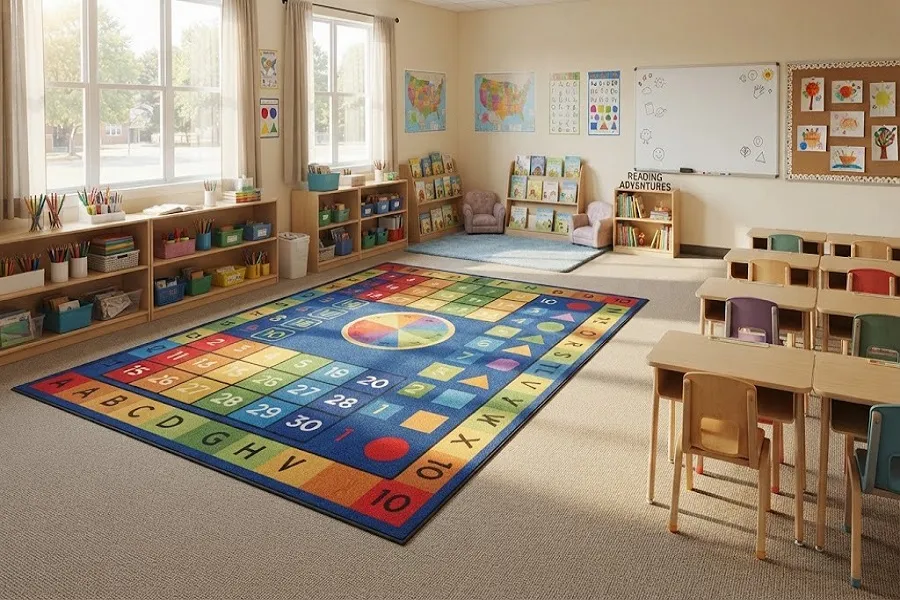
A classroom rug is a floor covering made for school use. It is built to handle heavy foot traffic, spills and daily seating. Some are plain. Others carry letters, numbers, maps or seating squares.
Classroom Carpets vs Classroom Area Rugs
People use these terms in different ways. Here is a simple way to think about them.
- Classroom carpets usually means fitted or wall-to-wall flooring that covers most of the room.
- Classroom area rugs are separate rugs that cover one part of the room, such as the reading corner.
- Carpet tiles are small squares that you lay in any shape and replace one at a time.
If you share a room or like to move things around, an area rug or tiles give you more freedom. If the whole floor needs replacing, fitted carpet may make more sense.
What Makes a Rug Educational
Educational carpets for classrooms carry a learning feature. This might be an alphabet border, a number line, a map or squares that give each child a seat. Young children learn by seeing the same things every day. For older students, plain designs often work better because they suit more kinds of lessons.
10 Best Classroom Rug Types
These are types of rugs, not products. Use this list to match your needs to a style. It is a simple way to narrow down the best classroom rugs for your own room, your class size and your teaching style.
1. Large Seating Rug With Assigned Spots
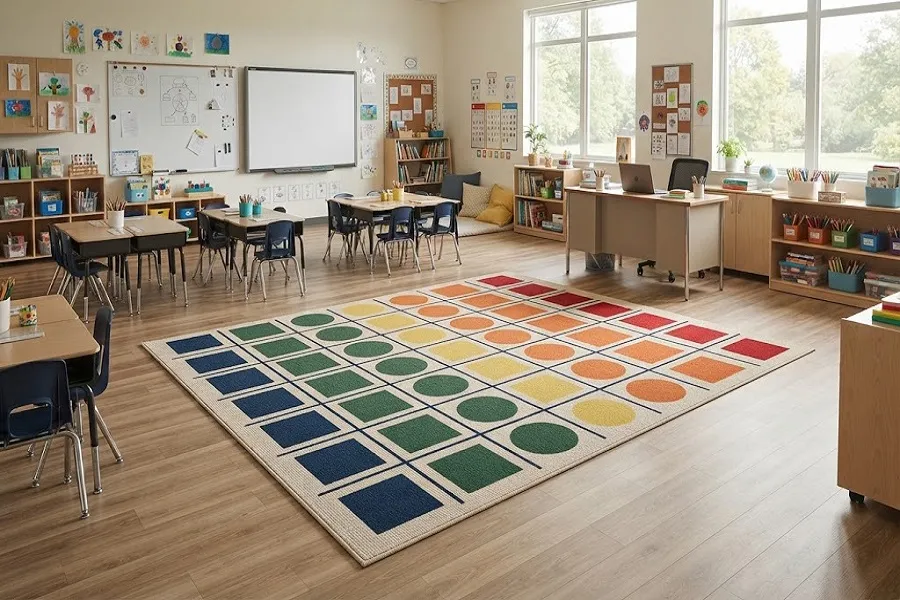
A large seating rug gives every child a marked square, circle or stripe to sit on. Children learn quickly where their spot is, so lining up and settling down take less time. This makes it one of the most useful picks for a classroom rug for teachers who want a calm, orderly group time. Count the spots before you buy and make sure there are a few extra for new students or visitors.
- Best for: Whole-class lessons, morning meetings and read-alouds
2. Alphabet and Number Learning Rug
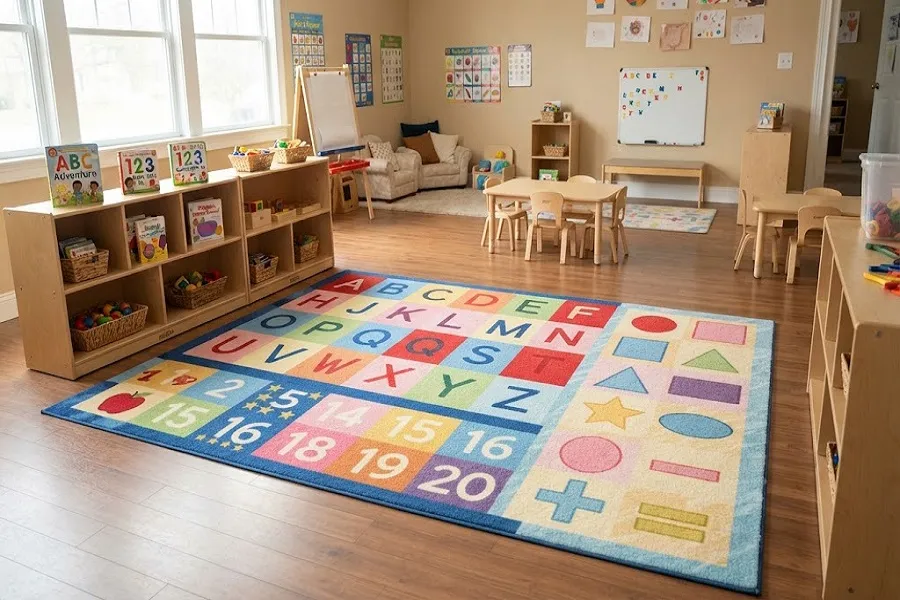
Educational carpets for classrooms turn the floor into a quiet teaching tool. Children can point to letters, count along a number line or trace a shape while they sit. Because the learning is built into the rug, young children see it every day without extra effort. Choose a clear layout with plenty of space between the images, so the rug does not feel crowded.
- Best for: Preschool and early elementary learners
3. Rainbow Squares Rug
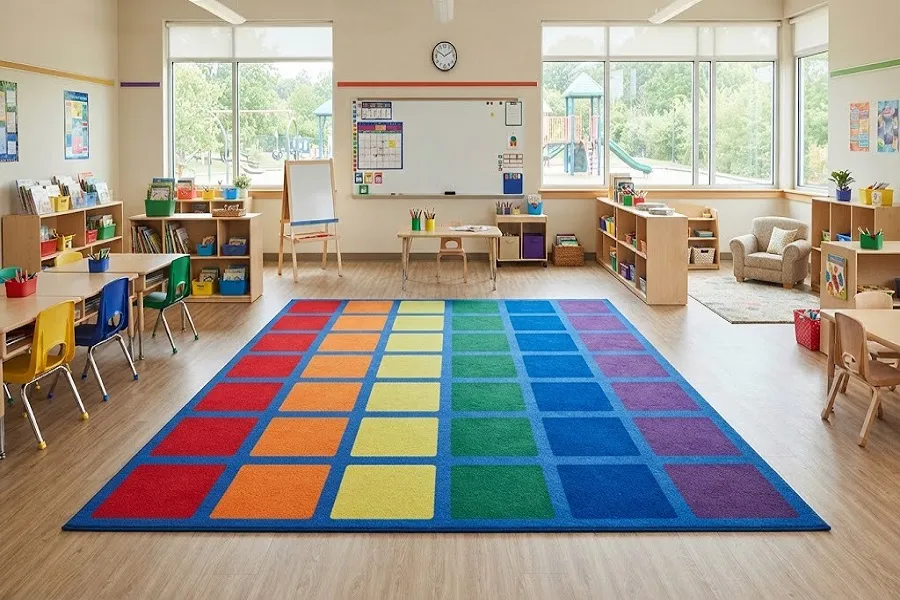
A rainbow squares rug is a classic for a reason. The squares act as seats, and the bright colours make the room feel warm and welcoming. The pattern is simple, so it fits most room styles and does not fight with wall displays. Many teachers pick this style because it works well for both teaching and play, which makes it a flexible choice among teacher rugs for classroom use.
- Best for: Mixed-age rooms and bright, busy spaces
4. Round Storytime Rug
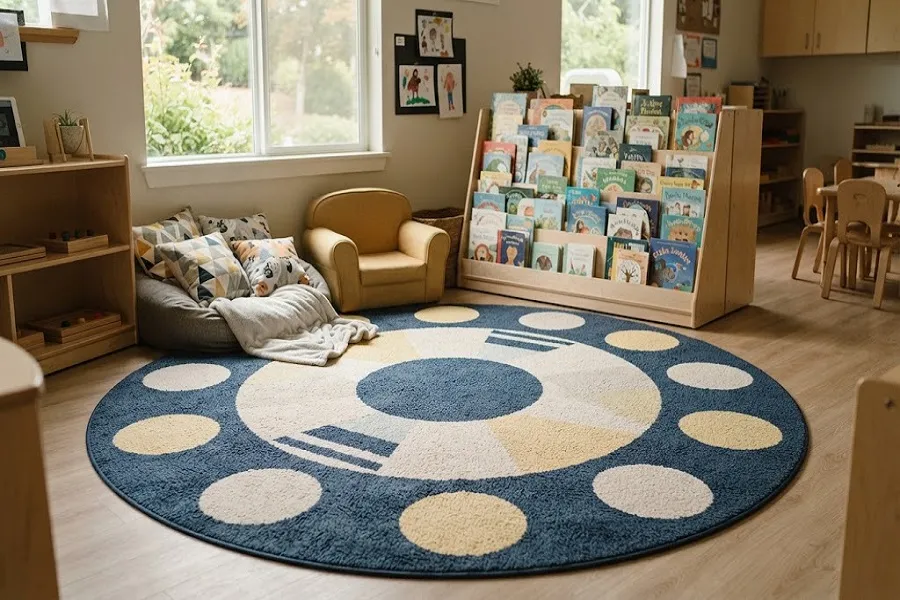
A round rug puts everyone on equal footing. Children sit in a circle, face each other, and no one gets stuck at the back. This shape suits sharing time, songs and stories, because every child can see the teacher and each other. A round rug also softens a room full of straight lines. Keep in mind that round rugs hold fewer children than a rectangle of similar width.
- Best for: Reading corners, circle time and small to medium groups
5. Kindergarten Carpet With Play Themes
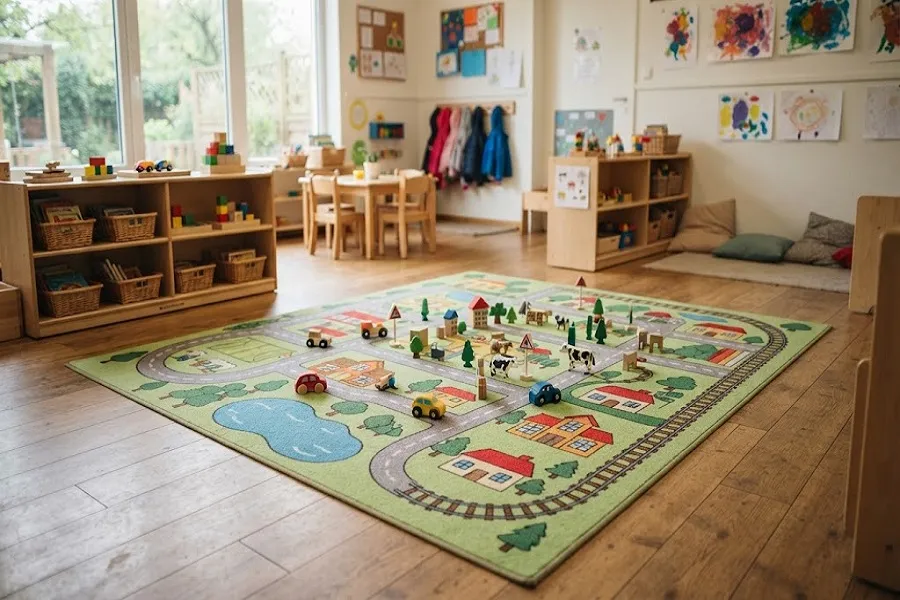
A kindergarten carpet with a play theme can show roads, farms, towns or nature scenes. Children use toy cars, animals and blocks right on the rug, which supports pretend play and early social skills. The design should add to play without taking over lessons. If the picture is too busy, children may find it hard to focus when you want their attention on you.
- Best for: Young children who learn through play and movement
6. Carpet Tiles for Flexible Layouts
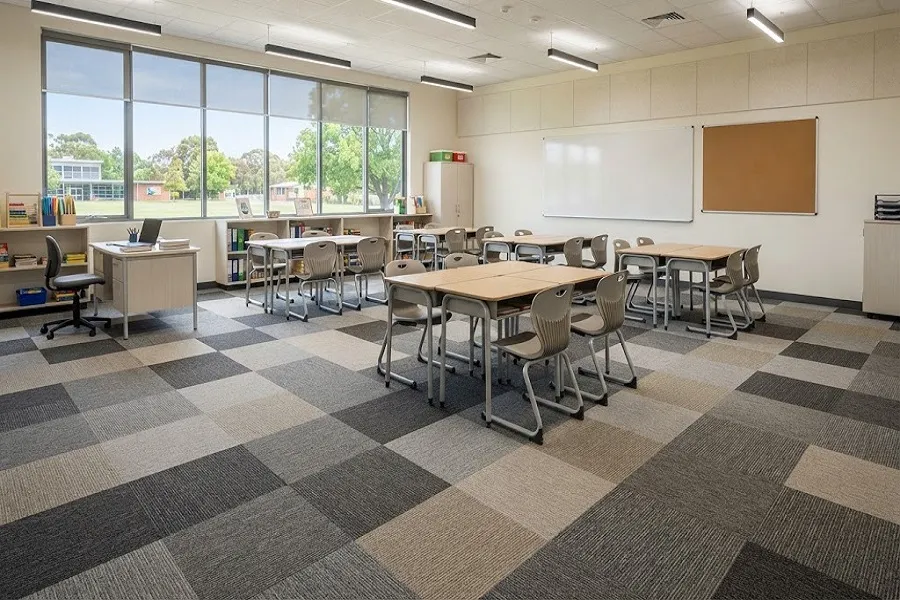
Carpet tiles are small squares that you lay out in any pattern. You can make a long reading strip, a square for group work or an odd shape that fits around a pillar. If one tile gets stained or worn, you replace only that piece. Tiles also let you change the layout as the room changes during the year, which older students often need for flexible seating.
- Best for: Odd room shapes, changing layouts and older students
7. Reversible Classroom Rug
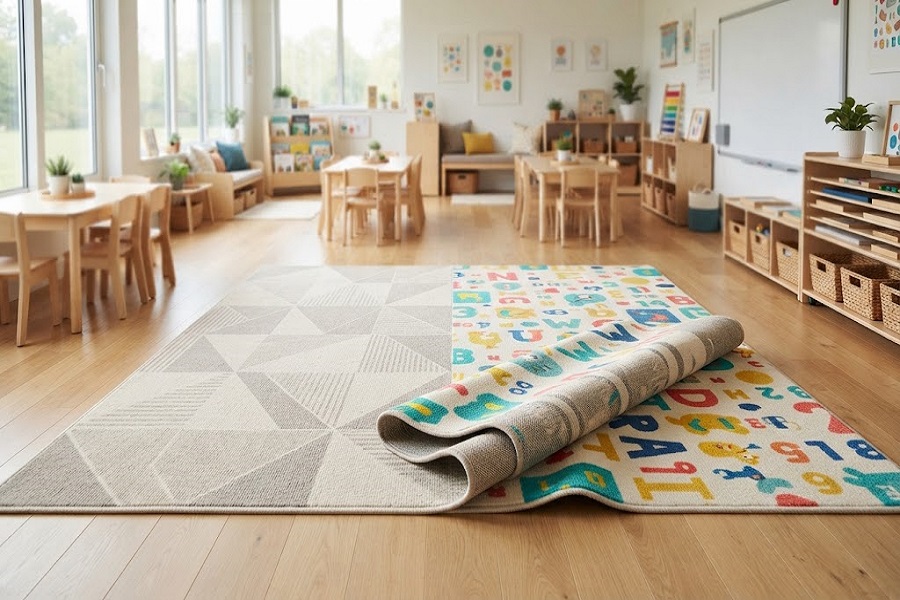
A reversible rug gives you two looks in one. One side might be plain and calm, and the other might be bright and playful. You can flip it depending on the activity, the mood or the season. This is handy for teachers who share a room or want to change the feel without buying a second rug. Check that both sides are well finished and that the rug lies flat after it is turned.
- Best for: Shared rooms and teachers who want two looks in one
8. Sensory and Calming Rug
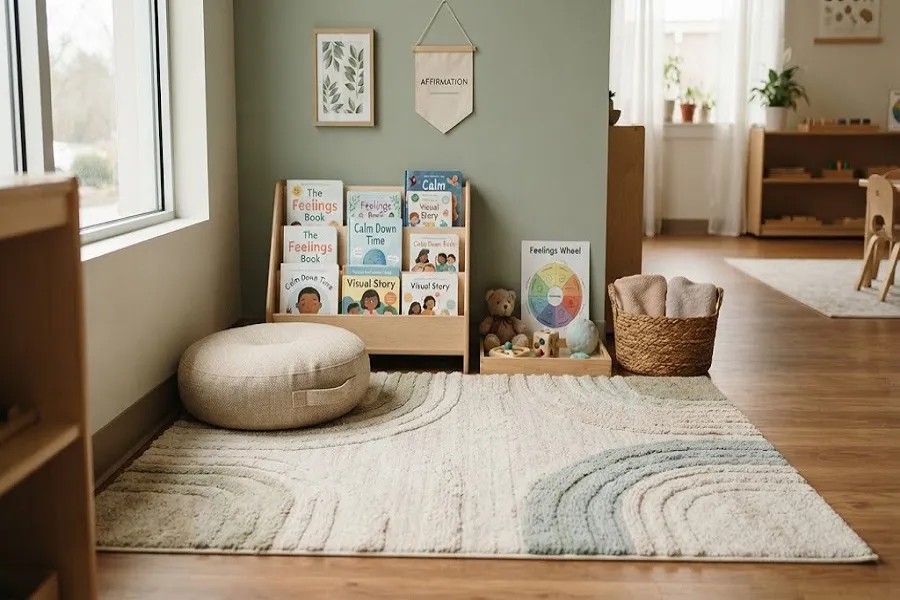
A sensory rug uses soft textures and gentle colours to help children settle. Many schools place one in a quiet corner where a child can take a short break and reset. Keep the pattern simple, because bold designs can be too busy for a space meant to feel calm. Choose a texture that feels pleasant but is still easy to vacuum and keep clean.
- Best for: Quiet corners and students who need a calm space
9. Budget-Friendly Rug
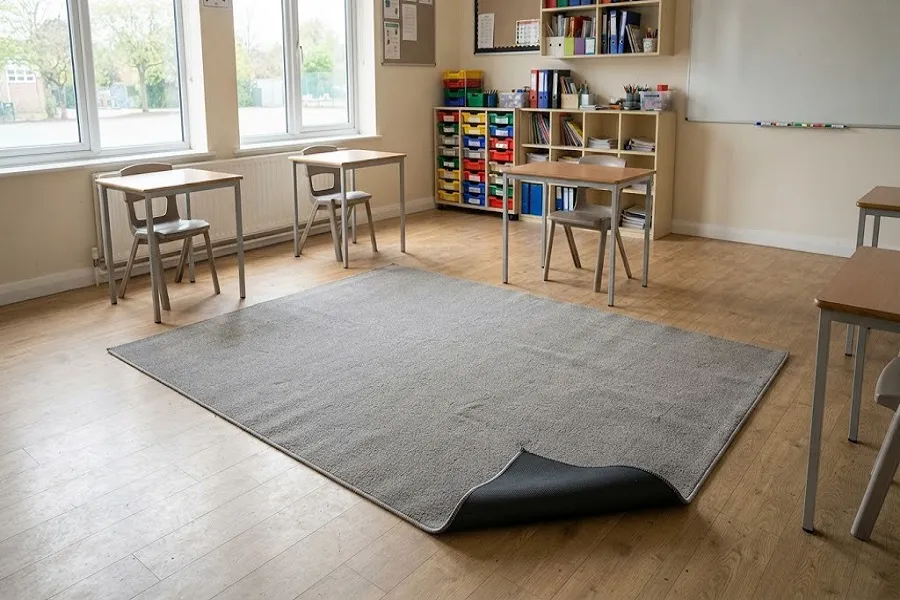
A simple, plain rug can be a smart pick when money is tight. A classroom carpet cheap enough for a small budget can still be a good choice if the backing, edges and safety details are right. Skip fancy prints and extras, because they often add cost without adding value. Do not skip slip resistance and stitched edges, since a rug that slides or frays will cost you more later.
- Best for: Tight budgets and new classrooms
10. Stain-Resistant, Fire-Rated Rug for High-Traffic Rooms
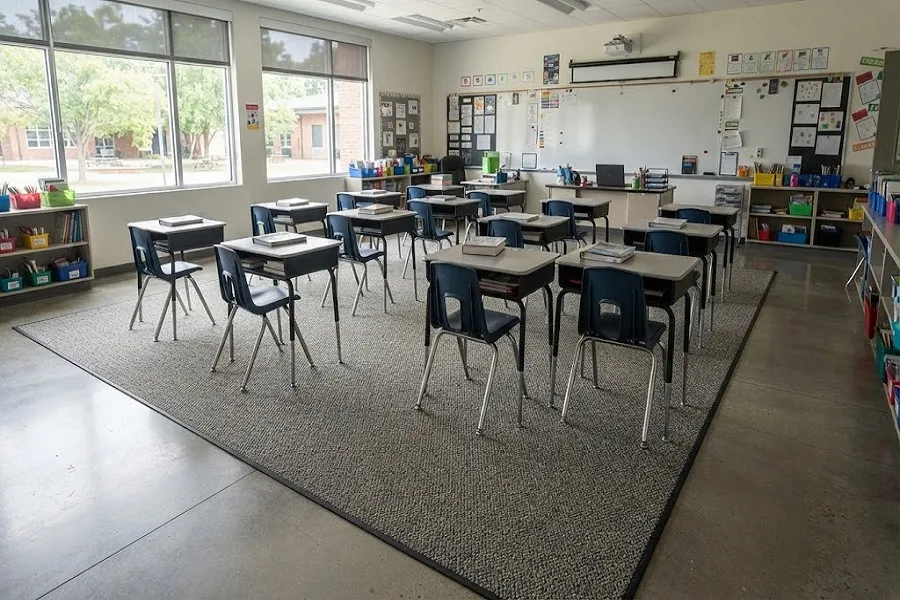
Some rugs are built for rooms that many classes use every day. Look for stain-resistant fibres, a strong backing and a low to medium pile that is easy to clean. Ask your supplier for fire test papers and low emission details, and check what your school or local authority requires. This type often costs a little more at first, but it can last longer in busy spaces.
- Best for: Busy schools, shared rooms and high-traffic areas
How to Choose the Best Classroom Rugs
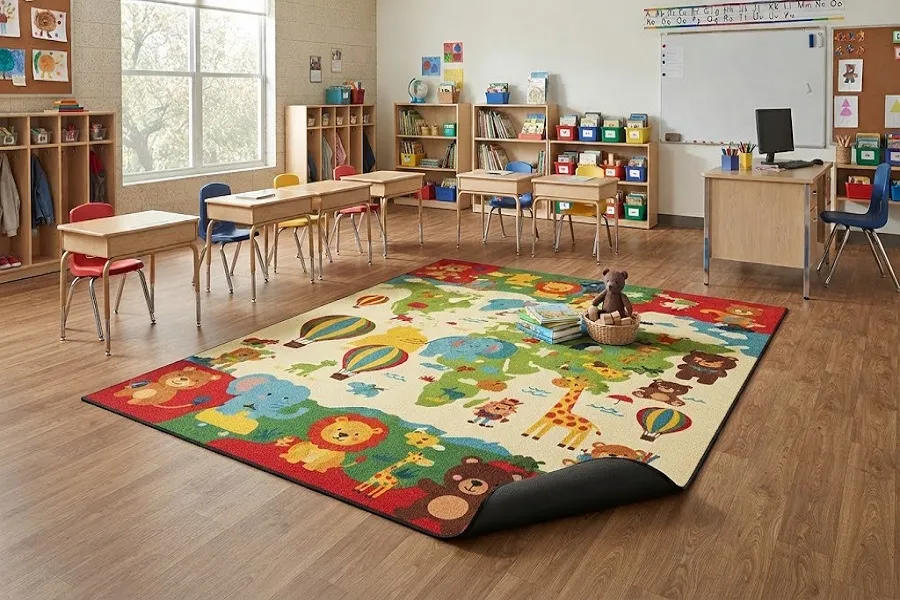 The best classroom rugs fit the room, handle daily wear and feel safe underfoot. Use the points below as a checklist.
Size and Seating Capacity
Big classroom rugs give every child room to sit, but a rug that is too large blocks walkways and desks. A simple method works well. Multiply the number of children by 4 square feet. That gives the floor space you need for seated children.
Measure the room before you shop. Leave a clear path around the rug. If the rug goes under a table, make sure the chairs stay on the rug when they are pulled back.
Shape
- Rectangle: Fits most rooms and works well with rows or seating squares.
- Round: Good for circle time because every child can see every other child.
- Half circle: Sits against a wall or whiteboard, which suits small groups with a teacher at the front.
- Oval: Softens a room and suits reading corners.
If you are not sure, a rectangle is the most flexible choice.
Material and Pile Height
Common Materials
- Nylon: Strong and springs back after heavy use.
- Polypropylene: Resists stains and moisture, and often costs less.
- Polyester: Soft and colourful, but it can flatten in busy spots.
- Wool: Wool rugs last a long time and feel natural, but they usually cost more and need gentle care..
Pile Height
Pile is the height of the fibres. The low pile feels flat. The high pile, like shag, feels fluffy. For classrooms, a low to medium pile is the smart pick. Crumbs and dust stay on top and are easier to vacuum. Blocks and toys stay steady, and chairs roll more easily. The cut pile feels softer, while the loop pile is flatter and tougher. A medium cut pile is a good balance for story time.
Backing, Edges and Slip Resistance
Turn the rug over and look at the back. A non-slip backing keeps the rug in place when children sit down or run across it. Check the edges too. Stitched edges stop fraying, and flat corners prevent trips. If you can get a sample, place it on the floor and push it with your foot. If it slides or curls, keep looking.
Fire Rating and Air Quality
Safety rules for floor coverings differ by country, city and school type, so do not guess. Ask your supplier for fire test papers and check what your school or local authority requires. Also ask about emissions. Some carpets and glues give off fumes when new. Children spend long hours indoors, so a low emission product is a good choice. A clear answer from the supplier is a good sign.
Design, Colour and Learning Features
Match the design to the age of the students. Young children enjoy bright shapes, letters and seating squares. Older students do better with calm tones. Very busy patterns can distract some children. Very pale rugs show every stain, and very dark rugs show dust and lint. Mid-tone colours and soft patterns hide dirt best. If the rug has seating squares, count them and make sure there are a few extra.
Stain Resistance and Easy Cleaning
Paint, glue, juice and snacks will reach the rug sooner or later. Look for stain-resistant fibres and a tight weave. Small patterns help hide marks and make how to clean a rug tasks easier. Ask whether the rug can be spot cleaned and how. Carpet tiles have one extra benefit: if one tile is ruined, you replace that tile and not the whole rug.
How to Find a Classroom Carpet Cheap Without Losing Quality
You can find a classroom carpet cheap and still get a good one. The trick is to know where to save and where to spend. Cheap teacher rugs and inexpensive classroom rugs are fine when the basics are right. A rug that falls apart after one term costs more in the end.
- Buy only the size you need. Use the 4 square feet per child rule.
- Choose a simple design. Plain or lightly patterned rugs often cost less.
- Compare cost per year. A rug that lasts four years can be cheaper than one that lasts one.
- Look for discount classroom rugs. Ask suppliers about end-of-line stock, remnants and bulk pricing for schools.
- Think about tiles. Start with a few and add more later.
Spend on the backing, the edges and the safety papers. Save on extras like complex prints.
Classroom Rug Size Guide
Use this table as a starting point. It is based on about 4 square feet per child.
| Number of students | Floor space needed (about) | Common rug size | Best shape |
| 8 to 10 | 32 to 40 sq ft | 6 x 6 ft (1.8 x 1.8 m) | Round or square |
| 12 to 15 | 48 to 60 sq ft | 6 x 9 ft (1.8 x 2.7 m) | Rectangle |
| 16 to 20 | 64 to 80 sq ft | 8 x 10 ft (2.4 x 3 m) | Rectangle or oval |
| 21 to 24 | 84 to 96 sq ft | 8 x 12 ft (2.4 x 3.6 m) | Rectangle |
| 25 to 30 | 100 to 120 sq ft | 9 x 12 ft to 10 x 13 ft (2.7 x 3.6 m to 3 x 4 m) | Rectangle |
If each child has a marked square and stays seated, you can plan for a little less space, around 3 square feet each. If children lie down, build or move around, plan for more. Sizes vary between suppliers, so check the exact measurements before you order.
Best Classroom Rugs by Age Group
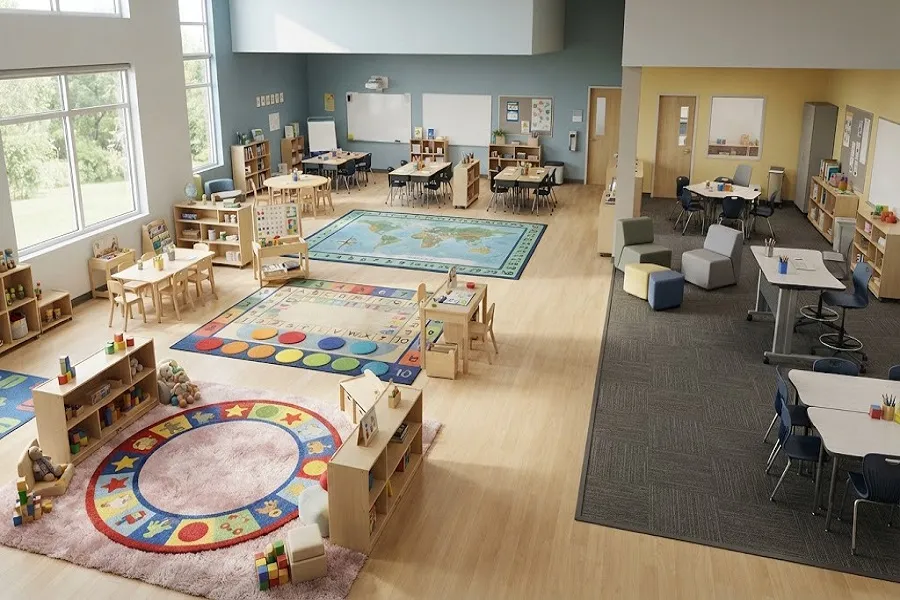
Each age group needs something different from a rug.
Toddler and Preschool
Young children spend much of their day on the floor. They crawl, stack, roll and play. Choose a soft rug with a medium pile and a wipe-clean surface. Rounded corners help. Bright, simple shapes work well, and a larger size leaves room to play without bumping into each other.
Kindergarten Carpet
A kindergarten carpet does a lot of work. It is the place for circle time, songs, stories and early lessons. Seating squares or circles help children learn where to sit. Letters and numbers add to learning. Pick a rug that handles spills and heavy use, because this age group tests every rug.
Elementary School
Elementary classes are often bigger, and children sit for longer periods. Choose a clean, easy-to-read design. Maps, number lines and calm borders work well. A rectangle suits most rooms and reading corners. Keep the colours balanced so the rug does not overwhelm the room.
Middle and High School
Older students rarely sit in a circle on the floor all day. A rug here often marks a reading nook, a quiet zone or a flexible seating area. Pick plain, neutral designs. Carpet tiles are a good fit, since you can change the layout when the room changes.
How to Clean and Maintain Classroom Carpets
Good care makes any rug last longer. A simple routine goes a long way.
- Vacuum often. Daily in busy rooms, or a few times a week at the least. Dusty or sandy areas need it more often.
- Blot spills right away. Press with a clean cloth. Rubbing pushes the stain into the fibres.
- Use gentle cleaners. Test on a small hidden spot first, since harsh products can fade colours.
- Schedule a thorough clean. Once or twice a year is common, and more often in very busy rooms.
- Keep the rug dry. Damp rugs can grow mould and smell bad.
- Rotate if you can. This spreads wear more evenly.
- Set a shoe rule. Grit wears a rug down fast, so a shoe policy for younger classes helps.
Read the care label first. If the rug is large or hard to move, professional cleaning is often the easiest choice.
Common Buying Mistakes to Avoid
- Buying from a photo alone. Colour and texture look different in person, so ask for a sample.
- Forgetting the floor underneath. On smooth tile, a thin grip layer can help if the rug backing is weak. Keep it slightly smaller than the rug so the edges do not stick out.
- Ordering too late. Check delivery time so the rug arrives before term starts.
- Skipping the return or damage terms. Know what happens if the rug arrives marked or the wrong size.
- Choosing a rug that is too heavy to move. You need to be able to clean the floor under it.
What Affects the Price of Classroom Rugs?
Prices vary a lot, so it helps to know what drives the cost.
- Size: Bigger rugs use more material.
- Material: Wool usually costs more than polypropylene or polyester.
- Backing and finishing: Strong backing and stitched edges add cost but improve safety and life span.
- Design: Detailed printed designs can cost more than plain ones.
- Safety testing: Rugs with fire and emission test papers may cost a little more.
- Custom orders: Made-to-size or custom designs cost more than standard rug sizes.
- Delivery and fitting: Large rugs may need special delivery.
When you compare, ask for the full price, including delivery. Then think about how many years the rug should last.
FAQs About Classroom Rugs
Q1. What size rug is best for a classroom?
It depends on how many children sit at once. Plan for about 4 square feet per child. A class of 20 usually needs a rug around 8 x 10 ft. Measure the room first and leave a clear walkway around the rug.
Q2. How many students fit on a classroom rug?
An 8 x 12 ft rug fits about 24 seated children. A 6 x 9 ft rug fits about 12 to 15. If children lie down or move around, fewer will fit comfortably.
Q3. What is the best material for classroom carpets?
Nylon and polypropylene are common picks because they handle heavy use and spills. Nylon springs back well, and polypropylene resists stains and moisture. Wool lasts long but costs more.
Q4. Do classroom rugs need to be fire-rated?
Rules differ by country and school. Many places set fire safety standards for floor coverings in schools. Ask the supplier for fire test papers and confirm what your school or local authority requires.
Q5. How do you clean a classroom rug?
Vacuum it often and blot spills right away with a clean cloth. Test any cleaner on a hidden spot first. Book a thorough clean once or twice a year, and make sure the rug dries fully.
Q6. Are cheap classroom rugs worth buying?
They can be, if the basics are good. Check the backing, edges and safety papers. A cheap rug with weak backing may slide or fray. Compare cost per year of use, not only the price tag.
Q7. What colours are best for a classroom rug?
Mid-tone colours and soft patterns hide dirt best. Bright colours suit young children, while calm neutrals suit older students and quiet areas. Very pale or very dark rugs show stains and dust more.
Q8. Should a classroom rug have seating squares?
For younger children, yes. Squares or circles help each child find a spot and keep group time calm. For older students, a plain rug is often better because it suits more uses.
Conclusion
A classroom rug is a small purchase that shapes how children sit, learn and move through the day. Start with size, then check the pile, backing, edges and safety. Match the design to the age of your students and plan how you will clean it.
Whether you need big classroom rugs for a whole class, a cosy kindergarten carpet or a simple budget option, the same rules apply. Choose a rug that is safe, easy to care for and made to last. Before you order, check with your school’s facilities team about floor rules, fire requirements and cleaning routines.


